In December 2024, I watched this video about how to make a realistic vegan turkey:
And there was nothing else I wanted to make for Christmas 2025.
Edgy Veg has their full recipe here, but I mutilated it a bit to reduce complexity and scale, and because I am not an influencer making vegan turkey for content and actually ate this for Christmas lunch, I also wanted to tell you the story of what happened to the leftovers afterward.
The Recipe
Here’s my completed recipe, with British measurements, no use of a mixer (as I don’t own one), no wings, and approximately half the size:
A Small Vegan Turkey Roast with Rice-Paper Skin
(serves 3)
This is a scaled-down vegan turkey designed for a small table. It uses seitan for structure, jackfruit for fibre, a simple stuffing to keep the interior tender, and a rice-paper skin adapted from vegan bacon techniques. It is cooked in a pressure cooker, then finished in the oven. This version focuses on good texture, good skin, and leftovers that reheat well.
Required equipment
-
Electric pressure cooker (5–6 litre capacity is ideal)
-
Trivet for the pressure cooker
-
Large mixing bowl
-
Blender or stick blender
-
Sharp knife
-
Foil
-
Roasting tin
-
Baking parchment
-
Small bowls for marinade and basting
-
Pastry brush (optional but helpful)
Ingredients
Seitan “turkey” dough
Wet ingredients
-
230 g firm tofu, drained
-
220 ml vegetable stock (double strength)
-
2 tbsp tahini
-
1½ tsp fine sea salt
-
1½ tsp onion powder
-
6 tbsp nutritional yeast
-
½ tsp liquid smoke
-
4 tsp white miso paste
-
1½ tsp poultry seasoning
Add-in
-
260 g young green jackfruit (from tins), well rinsed, seeds removed, squeezed very dry and finely shredded
Dry
-
270 g vital wheat gluten
Stuffing
-
300–350 g unbaked stuffing
It should be savoury and slightly moist rather than dry.
Rice-paper skin marinade
(all UK spoons)
-
2 tbsp olive oil
-
3 tbsp soy sauce or tamari
-
1½ tsp maple syrup
-
½ tsp liquid smoke
-
¾ tsp garlic powder
-
¾ tsp smoked paprika
-
½ tsp black pepper
-
¾ tsp mushroom seasoning or MSG
-
2 tbsp nutritional yeast
Mix thoroughly and keep whisking occasionally.
Basting liquid
-
2 tbsp oil
-
2 tbsp vegetable stock
-
1½ tsp maple syrup
-
Black pepper
Other
-
4–6 sheets rice paper
-
Skewers or cocktail sticks
-
Foil
Method
1. Make the wet base
Blend the tofu, stock, tahini, salt, onion powder, nutritional yeast, liquid smoke, miso and poultry seasoning until completely smooth. This step matters for texture.
Stir in the shredded jackfruit until evenly distributed.
2. Add gluten and mix
Add the vital wheat gluten all at once. Mix gently with a spoon or your hands until it just comes together into a shaggy dough.
3. Gentle kneading
Turn the dough out onto a clean surface.
Knead gently for 2–3 minutes only, folding and pressing rather than stretching. Stop as soon as the dough becomes cohesive.
If the dough feels crumbly, wet your hands and fold. Add liquid only one tablespoon at a time if absolutely needed.
Do not aim for elasticity. Over-kneading causes rubberiness.
4. Shape and stuff
Divide the dough:
-
About two-thirds for the body
-
The remaining third into two equal pieces for drumsticks
Flatten the body dough into a thick rectangle. Place the stuffing in the centre, then wrap the dough around it and seal gently. Shape into a compact oval roast.
Roll the two smaller pieces into short cylinders for drumsticks, tapering one end slightly.
5. Wrap and pressure cook
Wrap the body and drumsticks very tightly in foil, smoothing the surface.
Place on the trivet in the pressure cooker with water underneath.
Pressure cook on high pressure for 30 minutes, then allow a natural release of at least 10 minutes.
Remove and cool wrapped for 15 minutes, then unwrap.
Chill for 1–2 hours before skinning.
6. Apply the rice-paper skin
Prepare:
-
A bowl of warm (not boiling) water
-
The marinade
-
The basting liquid
Dip each rice-paper sheet briefly in warm water until pliable, then coat in marinade.
Use:
-
2–3 sheets for the body
-
½–1 sheet per drumstick
Smooth gently over the surface. Attach drumsticks to the body with skewers.
Brush lightly with basting liquid.
7. Roast, with vegetables underneath
Heat the oven to 200°C.
Line a roasting tin with baking parchment.
What to put underneath the turkey
Use chunky vegetables that roast rather than steam:
-
Potatoes
-
Carrots
-
Parsnips
-
Onion wedges
Toss lightly with oil, salt and pepper. Keep pieces large.
Place vegetables in a single layer, then sit the turkey on top so it is slightly raised.
Roasting
-
Cover loosely and roast for 20 minutes, basting once
-
Uncover and roast for 15–20 minutes until the skin is taut and lightly browned
Remove the turkey to rest for 10 minutes.
Return the vegetables to the oven for a further 10–15 minutes if needed.
Serving
Remove drumsticks if desired, then slice the body. Serve with gravy and the roasted vegetables underneath.
Soy-free variant
To make this recipe soy-free, make the following substitutions.
Replace tofu
-
Use 230 g cannellini beans or butter beans, drained and blended smooth
Replace miso and soy sauce
-
Omit miso entirely
-
Increase nutritional yeast by 1 tbsp
-
Add ½ tsp MSG or mushroom seasoning to the dough
-
In the skin marinade, replace soy sauce with 3 tbsp vegetable stock + ½ tsp salt
Ensure the vegetable stock is soy-free.
The method remains exactly the same. The soy-free version is slightly more tender in the centre and works very well with stuffing.
The Story
First of all, I had to buy a pressure cooker for this. There was no way round it, and I consoled myself that as commercially available meat alternatives are getting steadily more expensive, I could at least have a go at making my own, as nearly all meat alternatives involve pressure cooking vital wheat gluten at some point.
I bought an InstantPot, on the basis that, like airfryers, there is a ravingly enthusiastic fanbase that cannot stop putting everything in the world in their InstantPot. Four weeks later, I can report I am now going through a grief process of how many years I have lived without one and all of the meals that I could have made. You should buy one, and you should’ve bought one yesterday. Buy one now.
Secondly, all the instructions and photos will never explain to you what it actually tasted like, and what it tasted like was a seasoned turkey. As someone who spent the first decade of my vegetarian life consuming quorn and Linda McCartney sausages, I have been thrilled by the development of products like Richmond vegan sausages and Redefine meat, but the sausages are supposed to be bland and smooth and Redefine meat, which uses 3D printing, costs an absolute fortune. So I was genuinely shocked when I shoved together some flour, some tofu, and some jackfruit out a can and produced something with my own dyspraxic hands that was not unlike something I could’ve bought from a commercial canteen Christmas menu, and cost about £8 all in.
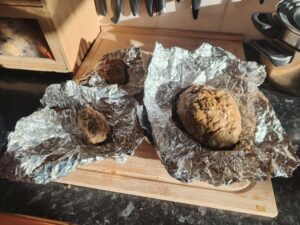
There were two points where you could know that it wasn’t meat – as the instructions warn repeatedly, too much kneading will result in a slight rubberiness. However, there is simply a limit to how much you can avoid kneading it during the process of shaping. My tester turkey (nicknamed the IVF turkey by my test subjects) was more distinguishably rubbery, because my initial recipe had been too dry and I had had to massage it a bit too much with water while sticking it together. For the full go, I was less precise about the amount of water involved and just pressed it together in the mixing bowl, which turned out to be all it needed. But there are still slight points where it just didn’t quite have the same bite. Whether that was inevitable or my neophyte attempt (I also didn’t shred the jackfruit as finely as I could have done), I don’t know.
The second point is – this isn’t a dead animal. At the end of the day, meat is shaped around cartilage, bones, and fat, and a meat alternative, however convincing in taste or even texture, will always have a uniformity that meat-eaters will have an uncanny valley reaction to. You cannot replace the pleasure of eating the oily miscellany of bits that you scraped off the bottom of the tray once you’re done carving around the bones of your dead animal. It is what it is. But for someone with opinions on vegan cheeses, it’s good enough.
Now, photos and commentary:
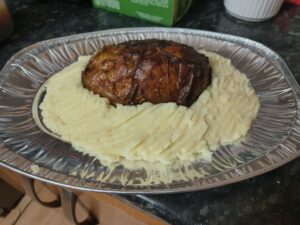
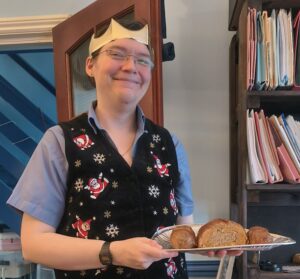
Because I’d never made this before, I made a small tester version without stuffing, which I fed to a small Christmas gathering of friends the week before. None were vegetarian. I looked at this lonely mass on my serving tray and felt compelled to add some mashed potato and gravy. Everyone ate it all. So the stuffing is not definitively required.
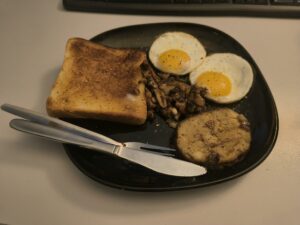
I still had about half the tester leftover though, so the next day, I tried experimentally frying it up for breakfast like a sausage patty. It fried up well and came out pretty much like a white pudding slice!
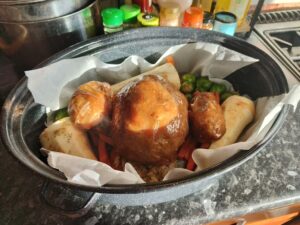
The original recipe anticipates you will be making something about three times the size and so I had bought a large roasting tin but, after the tester turned out pretty generously sized, I decided to cut it down considerably and suddenly my large roasting tin looked a bit cavernous. You’re supposed to elevate the turkey while it roasts so the ricepaper underneath doesn’t dissolve on you, so I balanced it on four onion halves and filled the rest of the space with veggies. I have to say that for all my recipe says it’s “for three”, because of my ADHD habit of worrying that we won’t have enough food, in addition to the veggies in this picture, there were also a tray of potatoes and a pot of peas. By the end, I clearly made enough food for six people in one oven and one hob. Just make sure you get your timings right so it’s all ready at the same time.
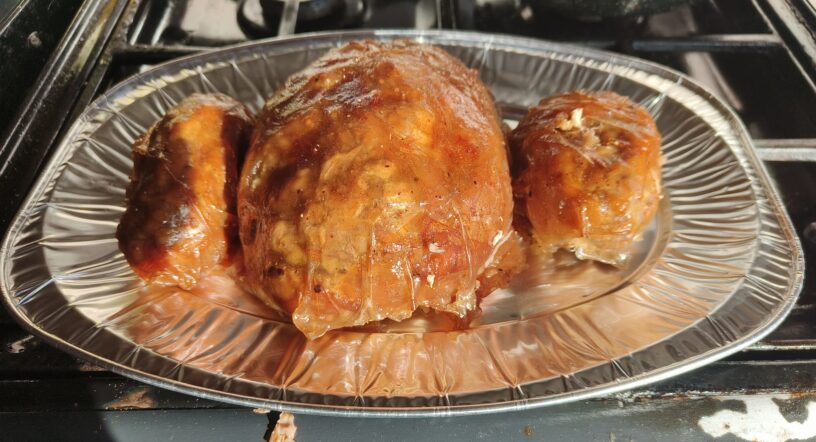
The final product. I have to say, I was a bit sceptical about rice paper skin but it was actually quite impressive. The starch means it’s slightly stiffer than dead animal skin and doesn’t pile up all floppy on your plate, but it also carves up much better because it retains the shape of the roast.
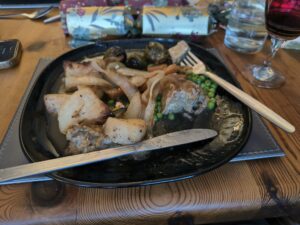
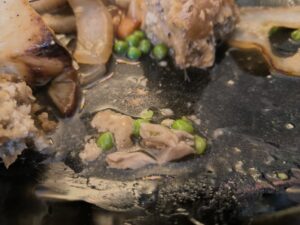 The turkey on the plate gives a nice visual – I took a close-up of the bits because it really does tear apart like turkey.
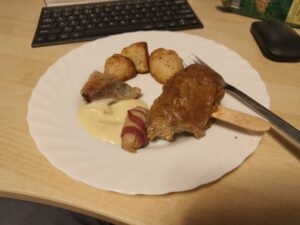
But what to do with the leftovers? Well, the first option is to just eat them cold. The drumstick in particular can be eaten from the stick like a bone and you, too, can pretend to be a medieval baron.
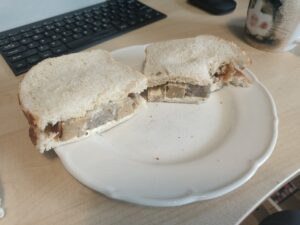
You can also eat it sliced up in a sandwich as a cold cut. The stuffing really comes into its own here and allows thicker slices than you might otherwise carve off.
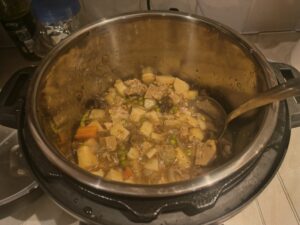
But after four days of eating turkey and trimmings in various forms, it was time to finish up what was left, so I threw everything in the pressure cooker, added a sauteed onion (you can saute in your InstantPot too!) and a made up jug of casserole powder, put on high pressure for five minutes (ten minutes natural release) and made a turkey casserole ready for boxing up and freezing. The ricepaper skin dissolves in the steamy environment and makes the casserole more gelatinous, which was great.
All in all, it was a genuine Christmas showstopper experience and I am very pleased with it.